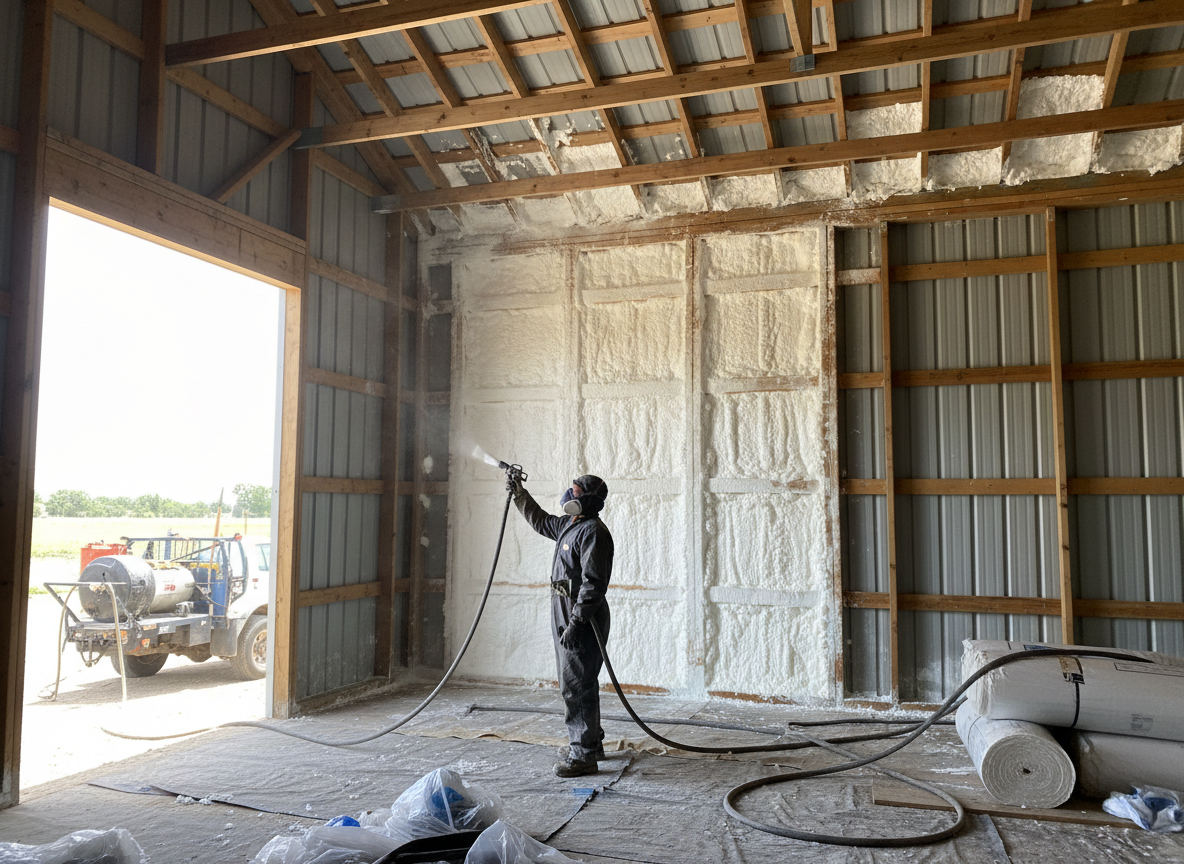
Pole barns in Midvale often feature metal siding and roofs that transmit cold quickly once winter temperatures drop below freezing in Salt Lake County. Proper insulation requires closed-cell spray foam or rigid board with taped seams to block air movement at the purlins and girts where most heat escapes. Homeowners in Old Town Midvale and near the Bingham Junction TRAX Station frequently discover condensation on the underside of roofs during temperature swings between cold nights and warmer days, so a continuous vapor barrier on the warm side prevents moisture buildup that can rust framing over time.
Installation crews must account for the semi-arid climate's low humidity in summer yet high risk of ice dams along eaves when snow accumulates. In pole barns used for equipment storage or workshops, we seal around doors, vents, and any penetrations to avoid creating cold spots that lead to frozen pipes or equipment issues. Work in areas like Bingham Junction often involves taller clearances and existing electrical runs that require careful routing to maintain insulation continuity without gaps.
Edge cases include older pole barns with dirt floors or partial concrete slabs where ground moisture can migrate upward if perimeter insulation is omitted. Salt Lake County building practices sometimes leave minimal roof overhangs, increasing wind-driven rain exposure that demands durable exterior-grade materials. We inspect for existing rodent activity common in rural edges near West Jordan before sealing, because insulation installed over active nests fails quickly.
Technician insight
In Midvale, the thing that catches most people out with pole barn insulation is underestimating how quickly metal roofs sweat once winter nights hit freezing while daytime temps climb. Many barns near Bingham Junction TRAX Station or Old Town Midvale sit on slightly sloped lots where ground moisture rises into the lower walls if perimeter insulation is skipped, and that detail changes the whole job.
Workshop Pole Barn Near Midvale City Park
The owner reported frost forming on interior metal walls during cold snaps. We found missing insulation at the eave line and no vapor barrier on the north wall. We added closed-cell foam along the full perimeter and sealed the ridge vent area. The barn now stays above freezing without extra heaters.
How it works
- 1
Site Assessment
Walk the pole barn interior and exterior to check roof condition, existing vapor barriers, door seals, and any penetrations while noting exposure to prevailing winds from the west.
- 2
Material Selection
Choose closed-cell foam or rigid boards based on R-value needs for Midvale winters and confirm compatibility with metal surfaces to avoid corrosion.
- 3
Preparation and Sealing
Clean surfaces, install vapor barrier where needed, and seal all gaps around purlins, girts, and utility entries before insulation application.
- 4
Installation and Finish
Apply insulation in continuous layers, trim flush at edges, and verify no voids remain at the ridge and eave lines before final walkthrough.
Pricing
Pricing depends on barn size, chosen material thickness, and access difficulty; we provide upfront quotes after the site visit.