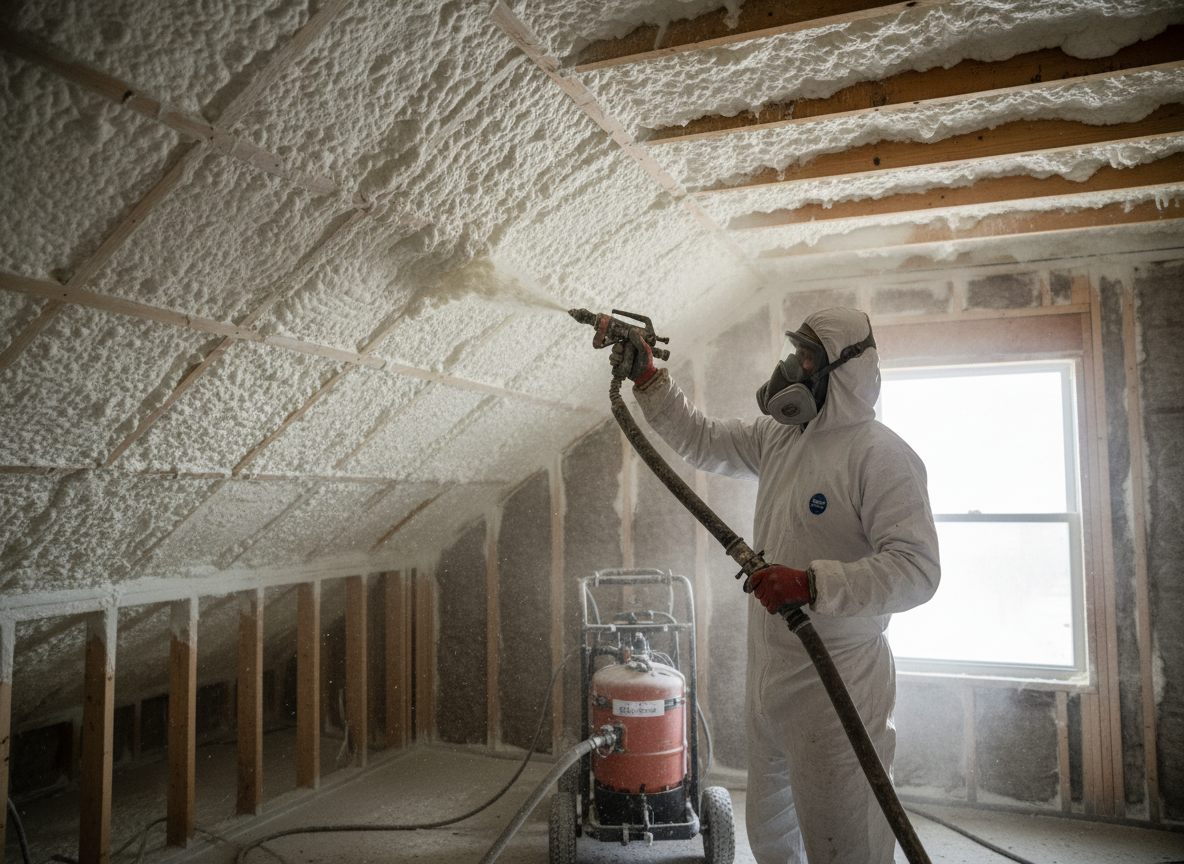
Spray foam creates an air-sealed barrier that performs well in Midvale’s semi-arid climate where cold winter nights pull heat out of older attics. Closed-cell foam adds structural rigidity and resists the occasional moisture drive that occurs when warm interior air meets the cold roof deck. Open-cell foam is sometimes chosen in vented attics to allow drying while still cutting airflow. Proper thickness matters because Salt Lake County code requires minimum R-values that change with roof pitch and existing insulation levels.
Homes in Old Town Midvale often have narrow access hatches and knob-and-tube wiring that must be identified before any foam is applied. Near the Bingham Junction TRAX Station, newer townhomes sit closer together, so overspray containment and neighbor notification become part of the job. In both cases we walk the attic first to map electrical runs, recessed lights, and exhaust vents so the foam stops short of heat sources and maintains required clearances.
Application happens after the attic is cleaned and any active leaks are fixed. We mask fixtures, apply the foam in lifts, and trim excess so baffles and recessed lights remain functional. Homeowners in West Jordan and Murray sometimes request a second pass after the first layer cures to reach the target R-value without exceeding joist depth. Final inspection includes checking for missed gaps around penetrations and confirming the foam has bonded to the sheathing.
Technician insight
In Midvale, the thing that catches most people out with spray foam insulation is the mix of older knob-and-tube wiring in Old Town Midvale homes and the need for thicker foam layers to handle our cold winter nights without trapping moisture against the roof deck.
Bingham Junction Attic Upgrade
A homeowner noticed high heating bills in a 1970s home near the Bingham Junction TRAX Station. We found large gaps around plumbing vents and thin fiberglass that had settled. After masking fixtures we applied closed-cell spray foam to the required depth, sealed the penetrations, and left the attic properly vented. The owner reported steadier indoor temperatures the following winter.
How it works
- 1
Attic Assessment
We inspect insulation depth, wiring, venting, and access points in Midvale homes to determine the right foam type and thickness.
- 2
Preparation
Fixtures are masked, leaks sealed, and safety zones marked around lights and wiring before any product is introduced.
- 3
Foam Application
Spray foam is applied in controlled lifts, building to the required R-value while maintaining clearances and ventilation paths.
- 4
Cleanup and Check
Overspray is removed, excess foam trimmed, and the attic is walked to confirm complete coverage and proper curing.
Pricing
Pricing varies with attic size, access difficulty, and foam type; we provide upfront quotes after the inspection.