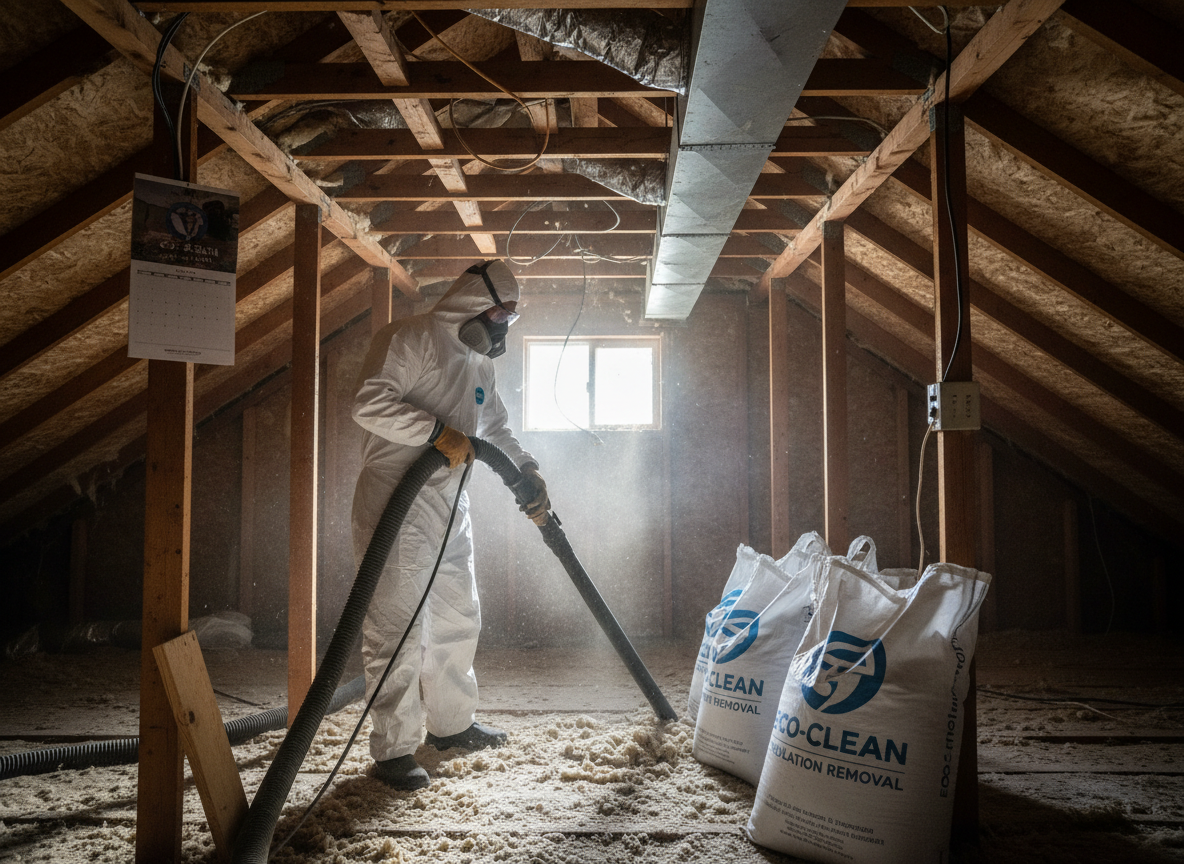
Midvale homes built before the 1980s in Old Town Midvale and near the Bingham Junction TRAX Station often contain original loose-fill cellulose or early fiberglass that has settled or absorbed moisture during the area's cold winters. Removal requires full containment to prevent fibers from drifting into living spaces below, especially in single-story ranch styles common along Fort Union Boulevard. Crews use negative-air machines and sealed chutes to pull material through the attic hatch without disturbing knob-and-tube wiring still found in some 1950s and 1960s houses.
Summer heat in the semi-arid Salt Lake Valley bakes attics to over 130 degrees, making daytime removal unsafe and increasing the risk of heat exhaustion for technicians. Work is scheduled for early morning or evening when temperatures drop. Homes near Midvale City Park frequently have low-pitch roofs that limit headroom, so technicians must use rakes and vacuums on hands and knees rather than walking upright. Proper disposal at Salt Lake County facilities is required for any material testing positive for older treated cellulose.
After removal, crews inspect for hidden roof leaks that are common where snow melts and refreezes along the eaves in West Jordan and Murray border areas. Missing baffles or blocked soffit vents are documented so homeowners can address ventilation before new insulation is added. This step prevents future ice dam issues that plague Salt Lake County homes during heavy winter storms.
Technician insight
In Midvale, the thing that catches most people out with insulation removal is how many older homes in Old Town Midvale still have knob-and-tube wiring running through the cellulose. One wrong step with a rake and you can create a short that shows up weeks later when the new insulation is already in.
Old Town Midvale Cellulose Removal
Homeowner in a 1962 house near Midvale City Park noticed uneven heating and suspected settled insulation. We found 14 inches of damp cellulose mixed with rodent debris. After full extraction and ventilation corrections, the attic was ready for new material without further moisture issues.
How it works
- 1
Site Assessment
Technician enters the attic from the address at 75 Fort Union Blvd C-102 and documents existing material type, depth, and any wiring or duct issues.
- 2
Containment Setup
Plastic sheeting and negative-air machines are placed to isolate the work zone and protect the home below.
- 3
Material Extraction
Insulation is raked and vacuumed into sealed bags or a collection truck, with special care around older electrical systems.
- 4
Cleanup and Inspection
Attic floor and access points are vacuumed, then the space is checked for remaining debris and ventilation problems.
Pricing
Cost depends on attic size, material depth, and access difficulty; upfront quotes provided after inspection.